• Skip to primary navigation
  • Skip to main content
Ningaloo Turtle Program/ Cape Conservati

Ningaloo Turtle Program/ Cape Conservati

Conservation of Marine Turtles and Their Associated Habitats

  • Home
  • About
    • Track Monitoring
    • Training
    • Ningaloo Reef
  • Volunteering
    • Volunteer Life
    • Dates and Costs
    • Volunteer Reviews
    • Positions
      • Volunteers
      • Team Leaders
      • Communications Intern
      • Local Exmouth volunteers
  • Jurabi Turtle Centre
    • Turtle Eco-Education Tour
    • Self-guided visits
  • Media
    • Videos
    • Gallery
    • 2022 School Posters
  • Resources
    • Turtles of Ningaloo
      • Hatchlings
      • Threats to Ningaloo’s Turtles
      • Green Turtles
      • Hawksbill Turtles
      • Loggerhead Turtles
    • Reports & Publications
    • Links
  • Show Search
Hide Search
Home/Resources/Turtles of Ningaloo/Threats to Ningaloo’s Turtles

Threats to Ningaloo’s Turtles

Learn about threats to the turtles of Ningaloo, as well as global threats to all sea turtles.

Development and Tourism

There is a growing tourist presence here at Ningaloo. If you plan to visit the Jurabi Coastal Park to view nesting or hatching turtles, it is imperative you follow the Turtle Watching Code of Conduct so your movements do not disturb the turtles. Thank you! 

If you are planning to look for turtles nesting or hatching, a good place to start is by booking a turtle eco-education tour, operating from the Jurabi Turtle Centre. You will be guided on how best to watch turtles in their natural habitat without disturbing them. Find out more here! 

Increasing tourism can mean increasing development. Built-up areas with lots of light pollution are not ideal for turtle nesting as the light disturbs and disorients turtles and hatchlings. Built-up areas also mean more people and consequently a higher chance of disturbance.

There is only one road along the Ningaloo Coast, which runs down the west side of the NW Cape, and the town of Exmouth is on the east side of the NW Cape, so light pollution from the town and road are minimal. However, the number of tourists visiting the Ningaloo region is increasing year on year, so it’s imperative that tourists familiarise themselves with the Turtle Watching Code of Conduct.

The Ningaloo Coast is a beautiful place to see turtles in their natural habitat, and with annual data collected by the NTP we know a lot about where and when turtles nest here, so we can continue to plan and manage the area in the turtle’s best interests. 

For example, many of the beach car parks are located very close to the ocean, in front of the dunes, so light from cars turning on their headlights in these beach car parks can disturb and disorient turtles and hatchlings. Data from the NTP helped provide evidence to allow a number of car parks to be re-located further away from where turtles nest, and those old car parks to be re-vegetated – increasing potential nesting space. 

If you are parking in a car park that is right beside the beach, please try and park with your headlights facing the road rather than the ocean – this will slightly reduce the amount of light reaching the turtles – thank you!


Artificial Light

Nesting adult turtles don’t like torches and other unnatural lights like cameras flashing! Neither do hatchlings.

Females will return to the water without laying if you shine a torch on them or snap a flash photo. Torch light is a big no-no! It is best to allow your eyes to adjust to the moon and starlight. When a turtle is actually laying eggs, you can use a dull red light on her rear end only, to observe the eggs coming out. 


Driving on Beaches

Driving on turtle nesting beaches is not allowed, but unfortunately some people disregard these rules and can run over nests. This means they potentially run over hatchlings that are just below the surface of the sand waiting to make the run to the ocean. Vehicles can also crush shallow nests.

Tyre tracks left behind by cars add another obstacle for hatchlings on their run to the ocean, as they can get disorientated by these deep trenches, and it increases the time they spend out in the open, leaving them vulnerable to sea gulls and other predators for longer than necessary.

Please do your part and park in the car parks, keep your car off the beach! 


Plastic and Litter

As human presence increases on the Ningaloo Coast, unfortunately so does the amount of litter found in the ocean and on the beaches.

Debris from fishing, including hooks and line are especially dangerous to marine fauna.

Turtles may also mistake plastic bags as one of their favourite foods – jellyfish – so please dispose of these appropriately. 


Boat Strikes

As turtles spend time at the surface to breathe, they are vulnerable to boat strikes which are unfortunately often fatal. Do your part by…

“going slow for those below”

A slower vessel speed means you are more likely to see all the wonderful wildlife Ningaloo has to offer too!


Cats, Foxes, and Domestic Dogs

Foxes can prey on turtle nests, digging up and eating eggs. Cats will prey on hatchlings. At the NTP we record when we see the tracks of an introduced predator on a turtle nesting beach, and any disturbed nests. This data can assist DBCA with planning where to set up baits and traps for non-native predators.  

Image right: Example of dingo tracks being recorded. Photo credit: Maddie Cayley

Cat, a non-native predator of turtle hatchlings.

Photo credit: DBCA.

Domestic dogs are not allowed on the turtle nesting beaches of Ningaloo but unfortunately can be present, and they can disturb turtles coming up to nest and dig up the eggs once laid. Their presence also leaves a scent, which can deter nesting females.

Please leave your dog at home, or alternatively, visit the beaches on the east side of the NW Cape where dogs are allowed and turtles won’t be disturbed. 


Native Predators

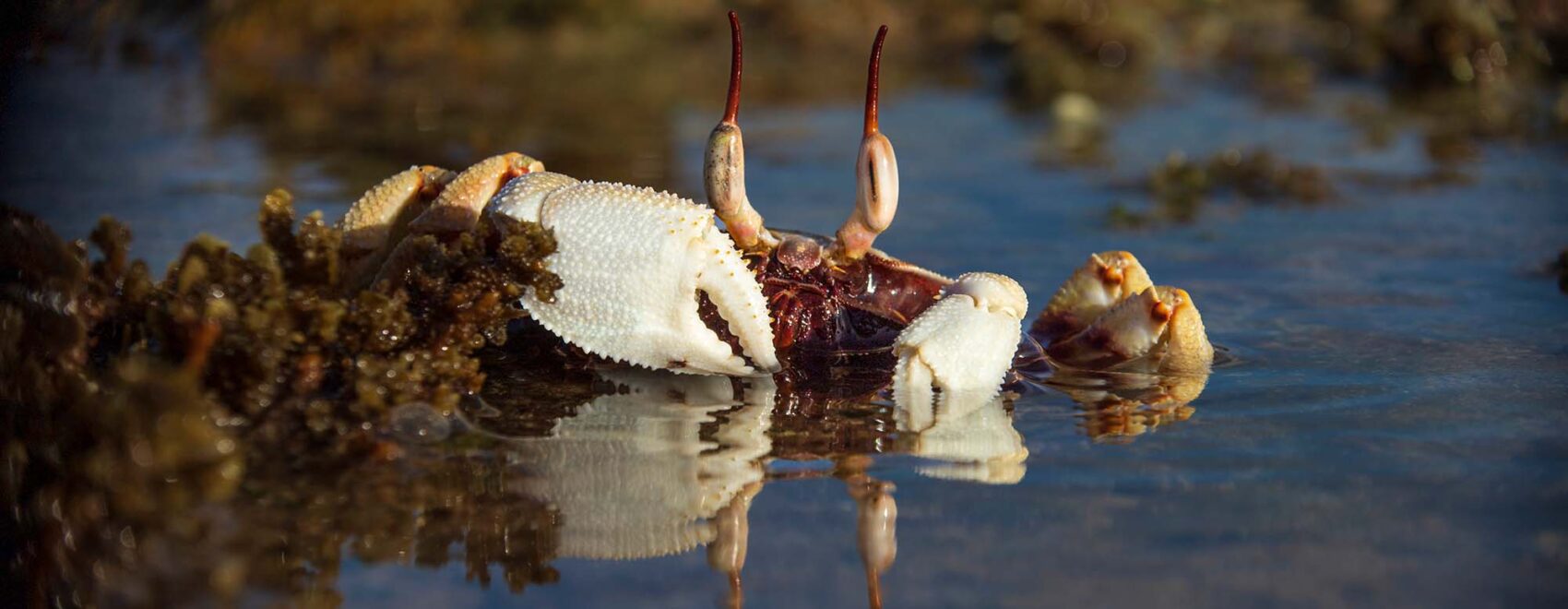
Golden ghost crab. Photo credit: Maddie Cayley

The turtles of Ningaloo have a number of native predators, including seagulls, ghost crabs, dingoes, and perenties. These animals can prey on turtle nests and eat the eggs, as well as feeding on the emerging hatchlings. 

Ghost crabs have become a serious problem along the Ningaloo Coast – predating eggs to the point where at the loggerhead rookery in Gnarraloo Bay, in one recent study, not a single hatchling hatched.

Ghost crabs are a native predator, but since colonisation certain human activities have created an abundant food source for the crabs and potentially reduced their predators as well. Consequently, they are predating turtle nests at an unnatural and unsustainable rate.  

Loggerhead turtles are endangered in Australia, and it is their nests on the Southern Ningaloo Coast that are taking the biggest hit from this surge in ghost crab activity. In response, field work is being carried out to explore methods of reducing the impact of crab predation on the loggerhead population. Watch this space!  


Global Threats to Sea Turtles

Trade in Animal Parts

Hawksbills, while listed as a Vulnerable species in Australia, are Critically Endangered globally (IUCN Red List). This is due in part to the lucrative trade in their shells for making jewellery, decorative items and tourist knick-knacks.  

Image left: Hawksbill on Ningaloo Reef. Photo credit: Emily Willis

Although Ningaloo is not the most common location for hawksbill nesting, the global threat to this species makes it even more important that we ensure this coast is a safe place for Hawksbills to nest so that we can do our part to help their population recover.  


Climate Change

Ningaloo Reef. Photo credit: Johnny Gaskell.

Climate change is a threat to us all, but with ocean temperatures increasing rapidly, turtles, and all marine species, are under threat. Ningaloo is a coral reef, and these are very fragile ecosystems sensitive to changes in temperature. If temperatures continue to increase our reef may not be able to support the thriving biodiversity it currently hosts.  

In regards to turtle nesting, the sex of hatchlings is determined by the temperature of the nest. We have a saying – “hot chicks and cool dudes” meaning that warmer temperatures create more female hatchlings. Climate change and increasing temperatures may lead to a feminisation of turtle populations world-wide, disrupting the natural balance. 

Footer

Ningaloo Turtle Program

PO Box 201
Exmouth
WA 6707

Ph: + 61 8 9947 8000
Email: ningalooturtles@dbca.wa.gov.au

Ngarnurra nhuna nhugurarrima Baiyungu, Thalanyji and Yinigurdira ganyarajarri thanardi ngarrari

We acknowledge Baiyungu, Thalanyji and Yinigurdira People as the original custodians of the land and water we manage

The Ningaloo Turtle Program appreciates the significant financial  contribution made by Woodside Energy and its joint venture participants Mitsui E & P Australia, Santos and Inpex. We thank them for their ongoing contribution.

Keep In Touch

  • Facebook
  • Instagram
  • YouTube
  • About
  • Volunteering
  • Jurabi Turtle Centre
  • Media
  • Resources